Brown & Michaels
How do I read a patent? - the Front Page
Let's look at the front page of a typical patent. We'll discuss each section on the front page, from left to right and top to bottom, identifying the sections by the number code in parenthesis before the section. These numbers, called "INID Codes", are used universally on all printed patents around the world, so that you can identify the information elements on a patent even if you do not speak the language. A complete list of these codes is available on this site. If any of the terms used in this explanation are unfamiliar, you will probably find them defined in our Patent Glossary.
Sample patent front page, from Patent Number 6,763,791
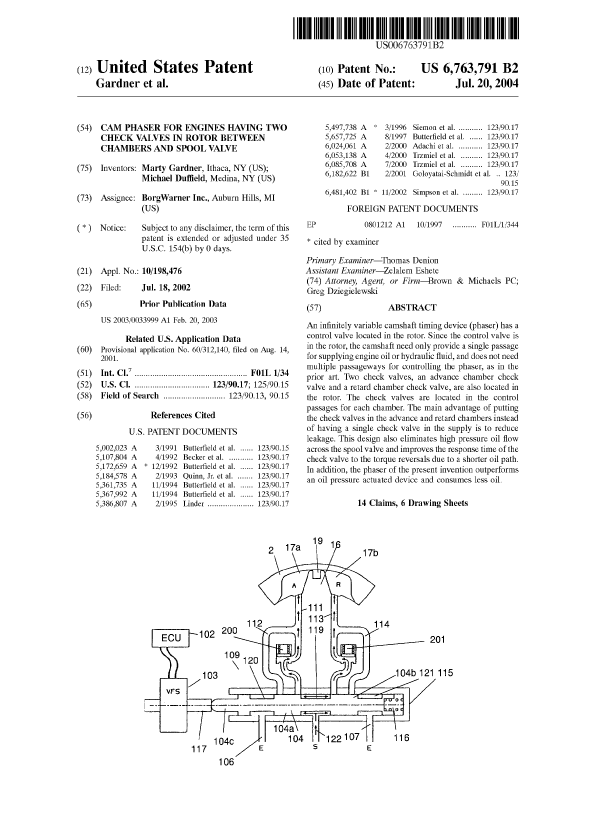
(12) Type of Document: for an issued patent, this will just read "United States Patent" (or, if appropriate, "United States Design Patent" or "United States Plant Patent"). Other possibilities are:
- "Patent Application Publication" - a published patent application. For more information on patent application publication, see our Patents FAQ page
- "Reissued Patent" - this patent is based on another patent which was previously issued. See section (22) for the number and issue date of that patent. The Reissue Patent has been examined and issued again with modifications to the claims.
- "Defensive Publication" or "Statutory Invention Registration" - a publication made for the defensive purpose of preventing others from getting patents. Defensive Publications and SIRs do not give any rights to exclude others from making, using or selling, as would a patent. SIRs were introduced in 1985, replacing the earlier Defensive Publication program, and were abolished (effective in March 2013) by the 2011 America Invents Act. The SIR program was never used very much - as of September 2011, only 2,264 SIRs had been published in 26 years.
The last name of the inventor will normally be printed under the type of document. If there is more than one inventor, this would be the last name of the first inventor followed by "et. al" (Law Latin for "and others").
(10) Number: A utility patent will have a number here with no letter prefix (other than the "US" which denotes a US publication). Other patent office documents have letter prefixes before the number which indicate the kind of document:
- AI - "Additional Improvement" patents, issued only between 1838 and 1861 - somewhat similar to today's "Continuation in Part" applications
- B - Re-examination Certificate, issued after a patent has issued and has been examined again by request of the patentee. The numeric portion of the number is the number of the patent to which the reexamination certificate refers. (For design, plant, reissue patents, the Reexamination Certificate will include the normal designation letter - BD for design, BP for plant, etc.)
- "B" was also used as a prefix for documents published in the Trial Voluntary Protest Program (TVPP) in the mid-1970's. Patent applications were partially published (abstract, drawing, cited references). First "B" publication was in June, 1975, and 665 "B" documents were eventually published.
- D or Des.- Design Patent - 14-year term, covers ornamental appearance of a useful object.
- H - Statutory Invention Registration (SIR) (published 1985-2013)
- NP - non-patent literature (not actually published by the USPTO, but some databases may show this code)
- PP or Plt. - Plant Patent - covers certain plants.
- RE - Reissue patent (RD for reissued design patent, RP for reissued plant patent)
- T - Defensive Publication (issued 11/5/68 through 5/5/87)
- X - Before 1836, patents were not numbered - they were simply described in terms of their inventor and date ("Brown's 1814 patent"). Some 9,957 patents issued between 1790 and 1836 were retroactively assigned "X" series numbers in the order in which they were issued. A fire at the Patent Office in 1836 destroyed most records of the "X" patents. Only 2,845 "X" series patents were reconstructed in the 1840's and are available today. Reissued "X" patents have an "RX" prefix.
Just for general interest, here's how utility patent numbers work out over the years:
| Utility Patent Number |
Issue Date | Years Between |
For |
| X1 | July 31, 1790 | - | Making Potash and Pearl Ash |
| 1 | July 13, 1836 | 46 | Traction Wheels |
| 1,000,000 | August 8, 1911 | 75 | Vehicle Tire |
| 2,000,000 | April 30, 1935 | 24 | Vehicle Wheel Construction |
| 3,000,000 | September 12, 1961 | 26 | Automatic Reading System |
| 4,000,000 | December 28, 1976 | 15 | Process for recycling asphalt-aggregate compositions |
| 5,000,000 | March 19, 1991 | 15 | Ethanol production by Escherichia coli strains co-expressing Zymomonas PDC and ADH genes |
| 6,000,000 | December 7, 1999 | 8 | Extendible method and apparatus for synchronizing multiple files on two different computer systems |
| 7,000,000 | February 14, 2006 | 7 | Polysaccharide Fibers |
| 8,000,000 | August 16, 2011 | 5 | Visual Prosthesis |
| 9,000,000 | April 7, 2015 | 3 | Windshield washer conditioner |
| 10,000,000 | June 19, 2018 | 3 | Coherent LADAR using intra-pixel quadrature detection |
Documents also have a letter or letter/number after the number. These appear on the face of the patent only after January 2, 2001, but the codes may be used on all patents in some databases. To make things more complicated, the number after the letter is sometimes omitted.
- A1 - Published Patent Application - (if application is published more than once, A2 for second, etc.)
- A1 - pre-2001 patents
- A9 - Corrected published patent application
- B1 - Utility Patent, not previously published
- B2 - Utility Patent, previously published as an application
- C1 - Reexamination Certificate (if more than one certificate, then C2, C3...) (B1 ... is used for pre-2001 Reexamination Certificates)
- E1 - Reissue Patent
- F1 - Reexamination Certificate of a Reissued Patent (F2, F3... for additional certificates)(before 2001, this was C1, C2...)
- H - Statutory Invention Registration (SIR). - see above
- I1 - "X" patent (see above)
- I2 - Reissued "X" patents
- I3 - Additional Improvement patent (see above)
- I4 - Defensive Publication ("T" series) (see above)
- I5 - Trial Voluntary Protest Program (TVPP) documents (see above)
- P1- Plant Patent (before 2001)
- P1 - Published Plant Patent application (after 1/2/2001 - additional publications are P4, P5...)
- P2 - Issued Plant Patent without pre-grant publication (after 1/2/2001)
- P3 - Issued Plant Patent which was previously published (after 1/2/2001)
- S - Design Patent
- X6 - Patent - Post Issue document (Dedication, Disclaimer, Cert. of Correction, etc.)
- X7 - Patent Assignment
(45) Date of Patent: the date the patent was issued by the USPTO. The patent is enforceable after this date, and in some cases the patent term is measured from this date (see "How to determine if a patent is still in force"). Interesting trivia point - this date is always a Tuesday.
(54) Title: This is the full title of the patent. In past years, it was the practice to give very vague and general titles to patents ("Tool"), but more recently titles tend to be fairly specific.
(75) Inventors: All of the inventors will be listed on the patent, usually with their city of residence. Sometimes the inventor's full address will be listed.
(73) Assignee: If the patent is owned by a company (or an individual other than the inventor(s)), it will probably be listed here. Note that this information comes from the cover sheet which was filed when the issue fee was paid, and may not be correct. Sometimes the attorney or inventor forgets to list an assignment, or chooses not to. Assignments which are recorded after the patent issues are never printed on the patent. To find out the latest assignment status of a patent, see the Patent Assignments database at the USPTO website.
(*) Term extension notice: Sometimes the term of the patent is extended due to delays in the USPTO processing beyond certain limits. If the term is extended, it will be noted here, as a certain number of days of extension (see "How to determine if a patent is still in force"). In the example above, the term was not extended.
(21) Appl. No.: The identifying number of the application on which this patent was based - in this case 10/198,476. The serial number is always six digits, assigned sequentially as applications are received by the USPTO, prefixed by a two digit series number. When the number reaches 999,999, they start a new series. The series numbers are as follows:
02 Application filed earlier than Jan. 1, 1948
03 Application filed Jan.1, 1948 - Dec. 31, 1959
04 Application filed Jan. 1, 1960 - Dec. 31, 1969
05 Application filed Jan. 1, 1970 - Dec. 31, 1978
06 Application filed Jan. 1, 1979 - Dec. 31, 1986
07 Application filed Jan. 1, 1987 - Dec. 31, 1992
08 Utility or Plant Application filed Jan. 1, 1993 - Dec. 31, 1997
09 Utility or Plant Application filed Jan. 1, 1998 - Dec. 4, 2001
10 Utility or Plant Application filed Dec. 4, 2001 - November 29, 2004, plus some "national stage" PCT applications filed after 2004 (the USPTO appears to have reserved some blocks of "10" series serial numbers for PCT applications, and continued to assign these numbers until they ran out).
11 Utility or Plant Application filed November 29, 2004-December 6, 2007
12 Utility or Plant Application filed from December 6, 2007 through December 17, 2010
13 Utility or Plant Application filed from December 17, 2010 through February 17, 2012
14 Utility or Plant Application filed from February 17, 2012 through January 2016
15 Utility or Plant Application filed after January 2016 (current series)
29 Design applications filed beginning in January 1993 (current series)
35 Hague Agreement application (after May 13, 2015)
60 Provisional Application filed before 2008
61 Provisional Application filed in 2008-mid 2014
62 Provisional Application filed in mid-2014 or later (current series)
90 Patent re-examination under Ex Parte Reexamination procedure
95 Patent re-examination under Inter Partes Reexamination procedure
(22) Filing date: This is the date that this application was filed. Note that this is the actual filing date, not necessarily the "first US filing date" used for determining patent term. (see "How to determine if a patent is still in force")
(65) Prior Publication Data: If this patent was published while it was a pending application, the publication number and date will be listed here. In this example, the application was published on February 20, 2003 as Published Application Number "US 2003/033,999 A1". For more information on patent application publication, see our Patents FAQ page
(60) Related US Application Data: and (30) Foreign Priority Data: If this application is related to any other applications or patents, they will be listed here. In this example, patent 6,763,791 was based on Provisional Application number 60/312,140 filed on August 14, 2001.
The patent might be related to other non-provisional applications, for example if it is a Continuation-in-Part of an earlier application or a US equivalent of an application first filed in Japan. If so, the patent term would be measured from the filing date of the earliest non-provisional US application listed here.(see "How to determine if a patent is still in force") If any of the related applications have issued as US patents, that will be indicated in this section as well.
(51) International Patent Classification All patents are classified by subject matter for ease of searching. The classifications in which a patent is indexed are listed in these sections. A given patent may be classified in any number of different locations, depending on the features of the invention.
Most patent offices around the world use the International Patent Classification system, which is based on the function or operation of the invention. The classification system is defined in a hierarchical outline. In this case, the patent is classified in subclass F01L 1/34, defined as follows:
F: MECHANICAL ENGINEERING; LIGHTING; HEATING; WEAPONS; BLASTING
F01: Machines or Engines
F01L: Cyclically Operating Valves for Machines or Engines
1/34: characterized by the provision of means for changing the timing of the valves without
changing the duration of opening
(52) US Patent Classification - CPC / USPC
Until January 1, 2015, the USPTO used its own US Patent Classification System (USPC) in which all inventions are first put in a class having a three-digit number, then in a numbered subclass under the class. The subclasses are arranged in a hierarchical form, but not necessarily in numerical order. The US classification system is more based on structure than function. In this case, the patent was classified primarily in subclass 123/90.17, defined as follows:
123 INTERNAL-COMBUSTION ENGINES
90.1 Poppet Valve Operating Mechanism
90.15 . With means for varying timing
90.17 .. Camshaft or cam characteristicsIn 2013 and 2014, the US Patent and Trademark Office and the European Patent Office coordinated their classification systems into a new system, called the "Cooperative Patent Classification" or "CPC". This classification system is based loosely on the IPC, but is more detailed and easier to use in our opinion. The two patent offices have a website on the CPC which explains how it works. For the same example given above, the CPC for this type of invention would be defined as follows:
F: MECHANICAL ENGINEERING; LIGHTING; HEATING; WEAPONS; BLASTING
F01: MACHINES OR ENGINES IN GENERAL; ENGINE PLANTS IN
GENERAL; STEAM ENGINES
F01L: CYCLICALLY OPERATING VALVES FOR MACHINES OR
ENGINES
F01L 1/x: Valve-gear or valve arrangements, e.g. lift-valve gear
F01L1/34 •characterised by the provision of means for changing the timing of the valves without changing
the duration of opening {and without affecting the magnitude of the valve lift
F01L1/344 • •changing the angular relationship between crankshaft and camshaft
F01L1/3442 • • • using hydraulic chambers with variable volume to transmit the rotating force
F01L2001/34423 • • • • Details relating to the hydraulic feeding circuit
F01L2001/34426 • • • • •Oil control valves
F01L2001/34433 • • • • • •Location oil control valvesAs of December, 2014, the USPC officially stopped the use of the USPC in favor of the CPC. Newly issued patents after January 2015 will no longer show USPC under the [52] INID code.
Knowing the US classification(s) for a patent was important in searching in the USPTO database before 2015, because patents issued before 1976 were only indexed by number and US classification. However, the USPTO has gone back and reclassified all existing patents by CPC on their search system (as has the EPO in its Espacenet system). As of January 1, 2015, the USPTO will no longer be updating the US Class information on its database, and have given notice that the USPCS information should be considered a "static collection". Therefore, it would be best practice not to use US Class in USPTO searching any longer. The EPO has also stopped the use of its own EPO classification system in favor of CPC, and Espacenet no longer has a search field for the EPO Classification. The IPC remains as an index term in both databases.
(58) Field of Search: These are the US classes/subclasses or CPC classes/subclasses the Examiner searched when he examined this patent. If you are doing a patent search and find a patent which seems similar to your idea, this can give you a hint of other places you should be looking.
(56) References Cited: This is a list of the prior art that the Examiner found in his search, or which were listed by the patentee on an "Information Disclosure Statement" (IDS) filed with the application. Patents flagged with an asterisk are those that the Examiner felt were particularly relevant to the patentability of this patent. Both US and foreign patents may be listed, as well as non-patent literature the Examiner might feel was relevant.
Primary Examiner, Assistant Examiner: These are the USPTO Examiners who did the examination of the application when it was filed in the USPTO.
(74) Attorney, Agent or Firm: When the Issue Fee is paid for the patent, one or more patent attorneys, patent agents or law firms may be listed on the cover sheet. In this case, the firm who filed and prosecuted the application was Brown & Michaels PC (surprised?) and Greg Dziegielewski was the Patent Counsel for the Assignee, BorgWarner Inc, at the time the patent issued.
(57) Abstract: A brief summary of the invention, with the emphasis on "brief" (less than 150 words). Note that the abstract is usually a much broader description of the invention than the claims, which actually define the limits of the patent's coverage.
Number of claims and drawing sheets: Simply an enumeration of the number of claims and sheets of drawing in the patent, so that you can determine if the copy you have is complete.
Representative drawing: The Examiner picks one of the drawing figures to put on page 1 of the patent. Usually, this is figure 1, but if the Examiner feels another figure shows the invention better, he will pick that one.
Ahead to the Drawings ->
Back to "How to read a patent" main page